Caught in the moment
Movement, emotion, drama
Renaissance & Baroque
Learn more about the famous masterpieces featured in this exhibit!
Sign up for evening activites!
Share your favorite pieces from the collection!
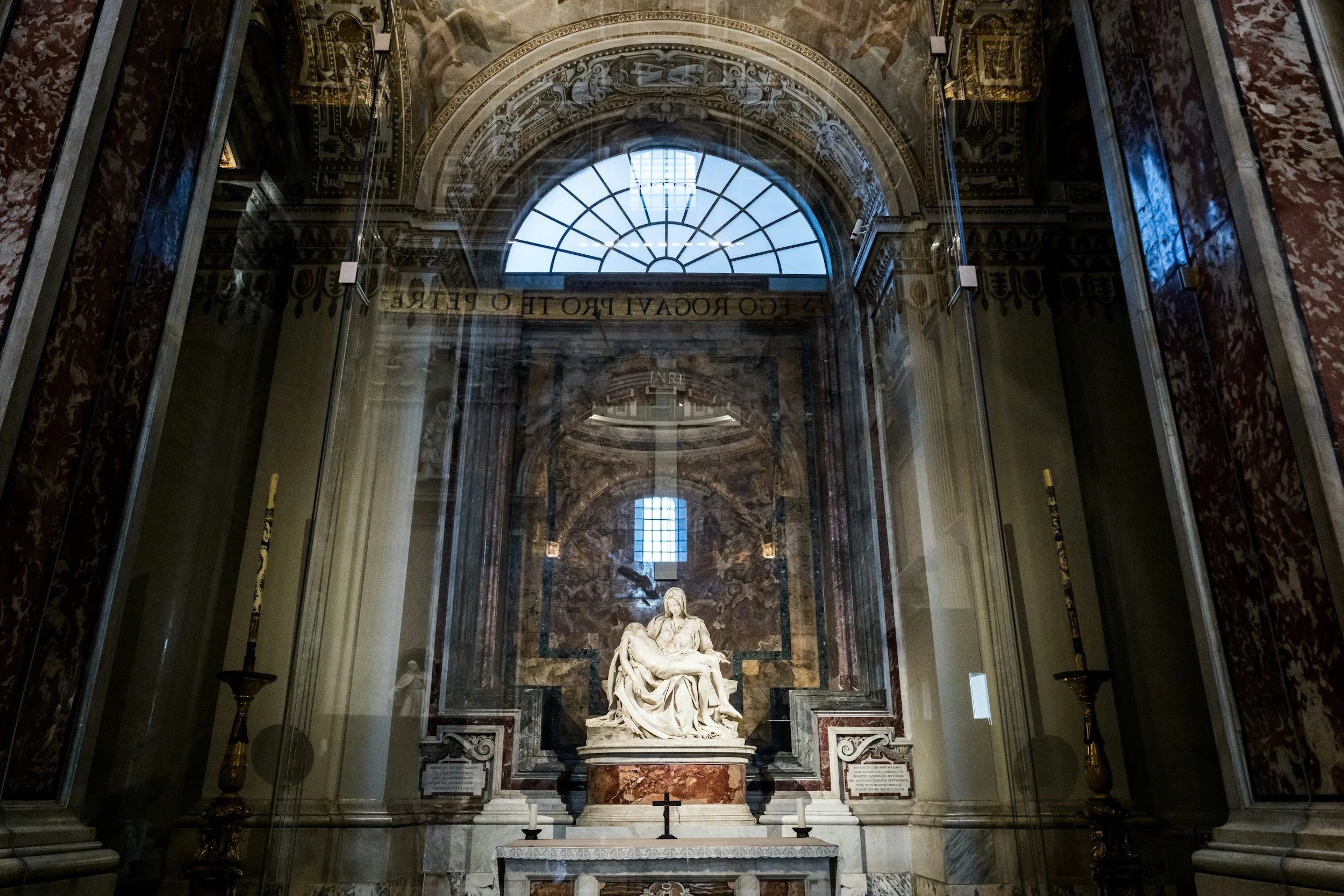
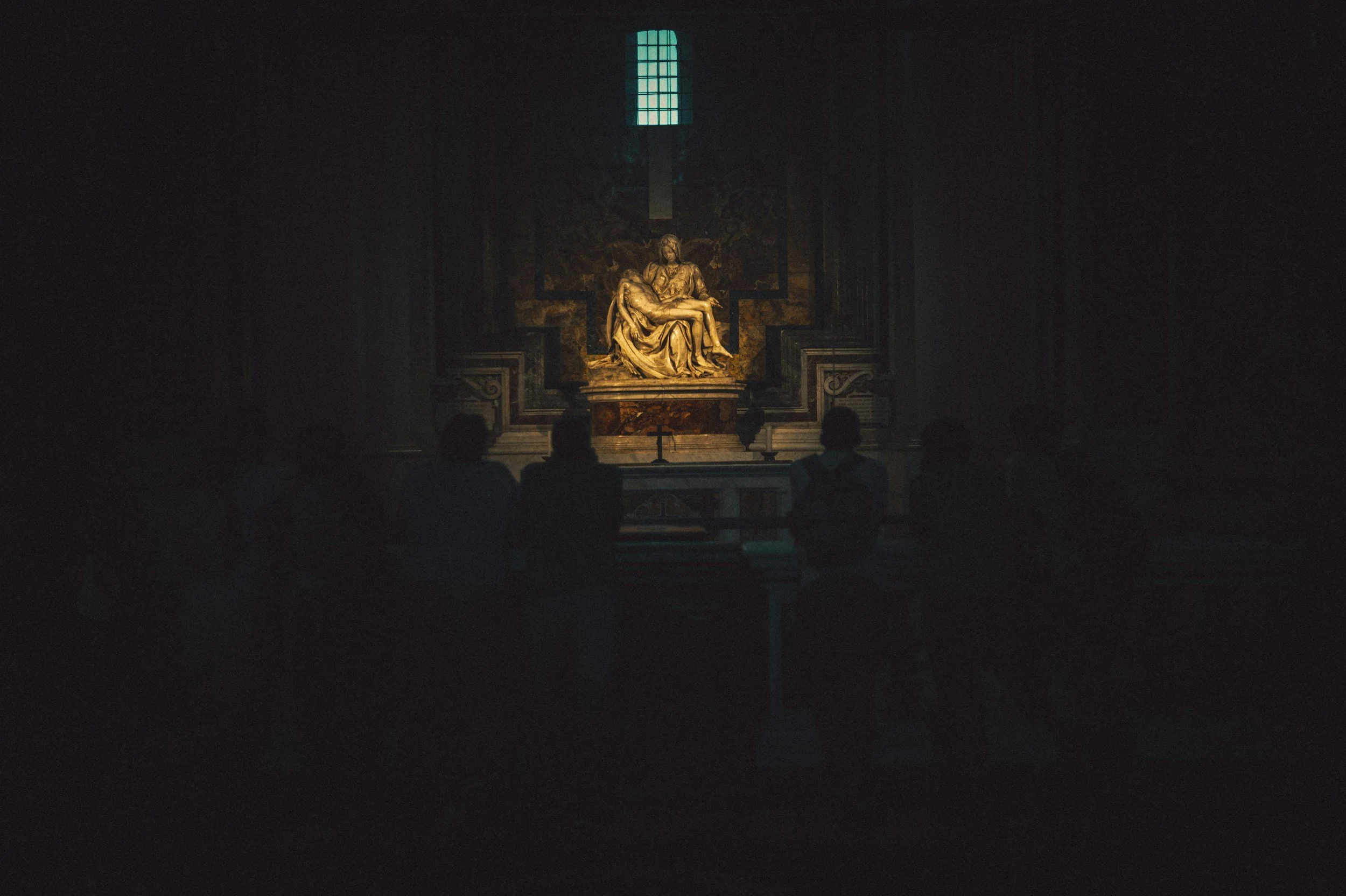
Michelangelo's Pietà is one of the defining masterpieces of the Italian Renaissance and is widely considered one of the greatest sculptures ever created. Carved from a single block of Carrara marble between 1498 and 1499, the sculpture depicts the Virgin Mary holding the lifeless body of Jesus Christ after the Crucifixion. The title Pietà, meaning "pity" or "compassion" in Italian, refers to the moment of mourning shared between mother and son. Although this scene is filled with sorrow, Michelangelo chose not to portray overwhelming grief. Instead, he created an image of quiet reflection, emphasizing faith, acceptance, and hope rather than despair.
The sculpture was commissioned by Jean de Bilhères, a French cardinal serving as ambassador to the Holy See, for his funeral chapel in the original St. Peter's Basilica in Rome. At the time, Michelangelo was only twenty-three years old and relatively unknown outside of Florence. Completing a work of this scale and complexity at such a young age immediately established him as one of the leading artists of the Renaissance. Today, the Pietà remains in St. Peter's Basilica, where it continues to inspire millions of visitors each year.
One of the most striking aspects of the sculpture is Michelangelo's mastery of naturalism. Christ's body is rendered with remarkable anatomical accuracy, from the tension in his muscles to the weight of his arm as it falls across Mary's lap. Despite being carved from marble, the skin appears soft and lifelike, while the folds of Mary's robes create rich textures and deep shadows. Michelangelo achieved this effect through careful observation of the human body and an extraordinary ability to transform stone into forms that seem almost alive.
Although the sculpture is highly realistic, Michelangelo made several intentional artistic choices. Mary appears much younger than would be expected for the mother of a thirty-three-year-old son. Rather than depicting her actual age, Michelangelo presented her as youthful to symbolize her purity, eternal virtue, and freedom from sin. Her calm facial expression also differs from many later depictions of the same subject. Instead of displaying intense anguish, she accepts Christ's sacrifice with quiet dignity, encouraging viewers to contemplate the spiritual meaning of the event rather than simply its tragedy.
The composition of the Pietà reflects the ideals of the High Renaissance. The figures are arranged in a stable triangular shape, creating a sense of balance and harmony. Every line leads the viewer's eye smoothly across the sculpture, from Mary's face to Christ's body and finally to her open hand, which appears to present Christ to the viewer. This careful organization gives the sculpture a feeling of stability even while depicting a moment of profound loss.
Michelangelo was deeply influenced by the art of ancient Greece and Rome, where idealized human forms and balanced compositions were considered the highest artistic achievements. He combined these classical influences with Christian subject matter, creating a sculpture that expresses both physical perfection and spiritual devotion. This blend of classical beauty and religious meaning became one of the defining characteristics of Renaissance art.
The Pietà also reflects Michelangelo's personal philosophy as a sculptor. He believed that every block of marble already contained a figure waiting to be revealed and that the artist's role was to remove the excess stone. His extraordinary technical skill is evident throughout the sculpture, from the polished surfaces of Christ's body to the intricate folds of Mary's clothing. In fact, the Pietà is the only sculpture Michelangelo ever signed. After hearing visitors mistakenly attribute the work to another sculptor, he carved his name across the sash running over Mary's chest—a signature that remains visible today.
Within the exhibition Emotion in Motion: Drama and Humanity in Renaissance and Baroque Art, the Pietà represents the Renaissance approach to expressing emotion. Rather than relying on dramatic movement or theatrical effects, Michelangelo communicates grief through subtle gestures, balanced composition, and idealized beauty. The emotional power of the sculpture comes from its restraint. This approach contrasts with later Baroque artists such as Caravaggio and Bernini, who used dramatic lighting, movement, and heightened realism to evoke stronger emotional responses. By beginning the exhibition with the Pietà, visitors can appreciate how Renaissance artists communicated profound human emotions through harmony and quiet contemplation before encountering the more dynamic and emotionally charged works of the Baroque period.
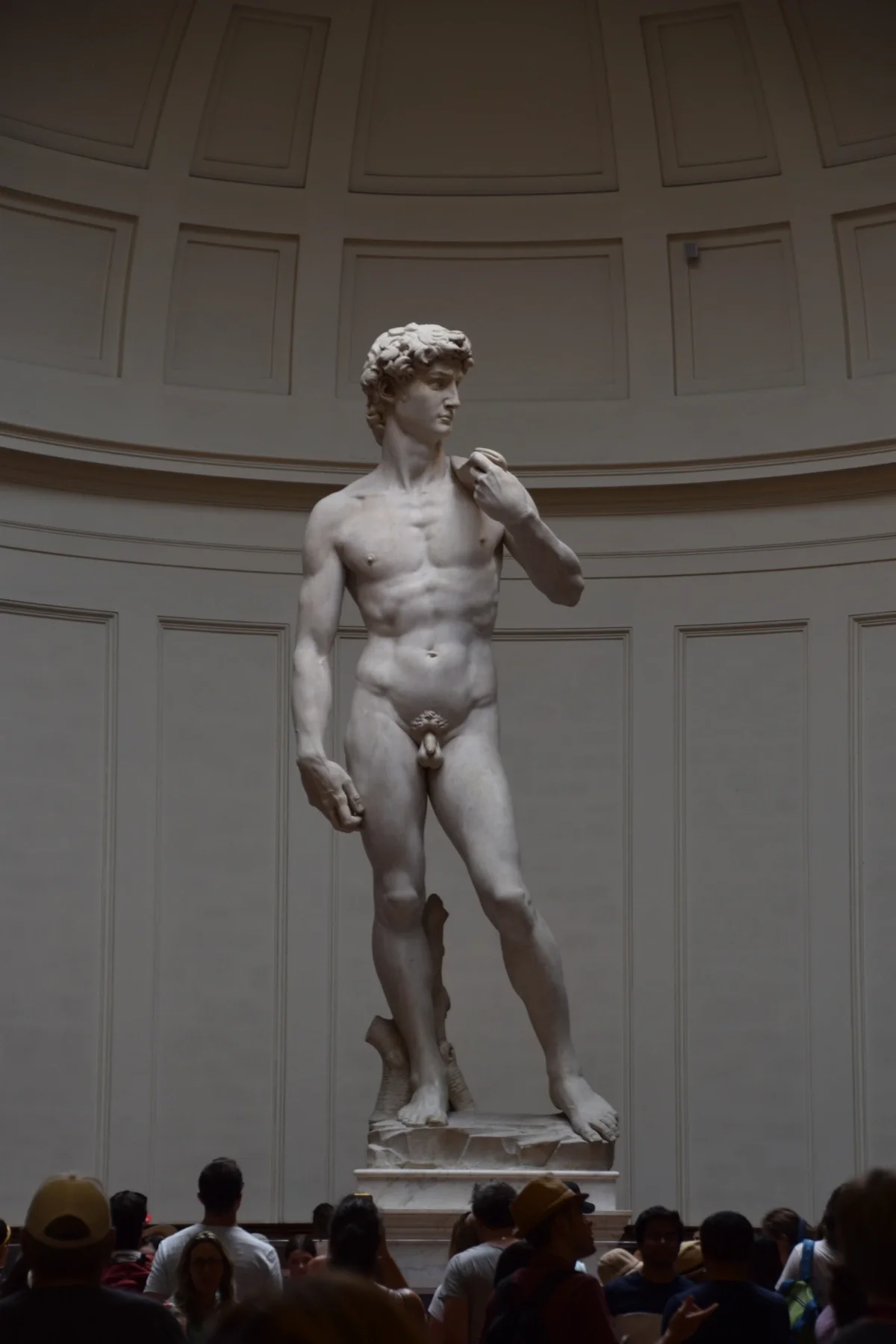
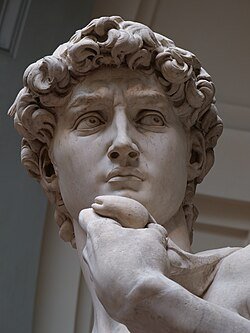
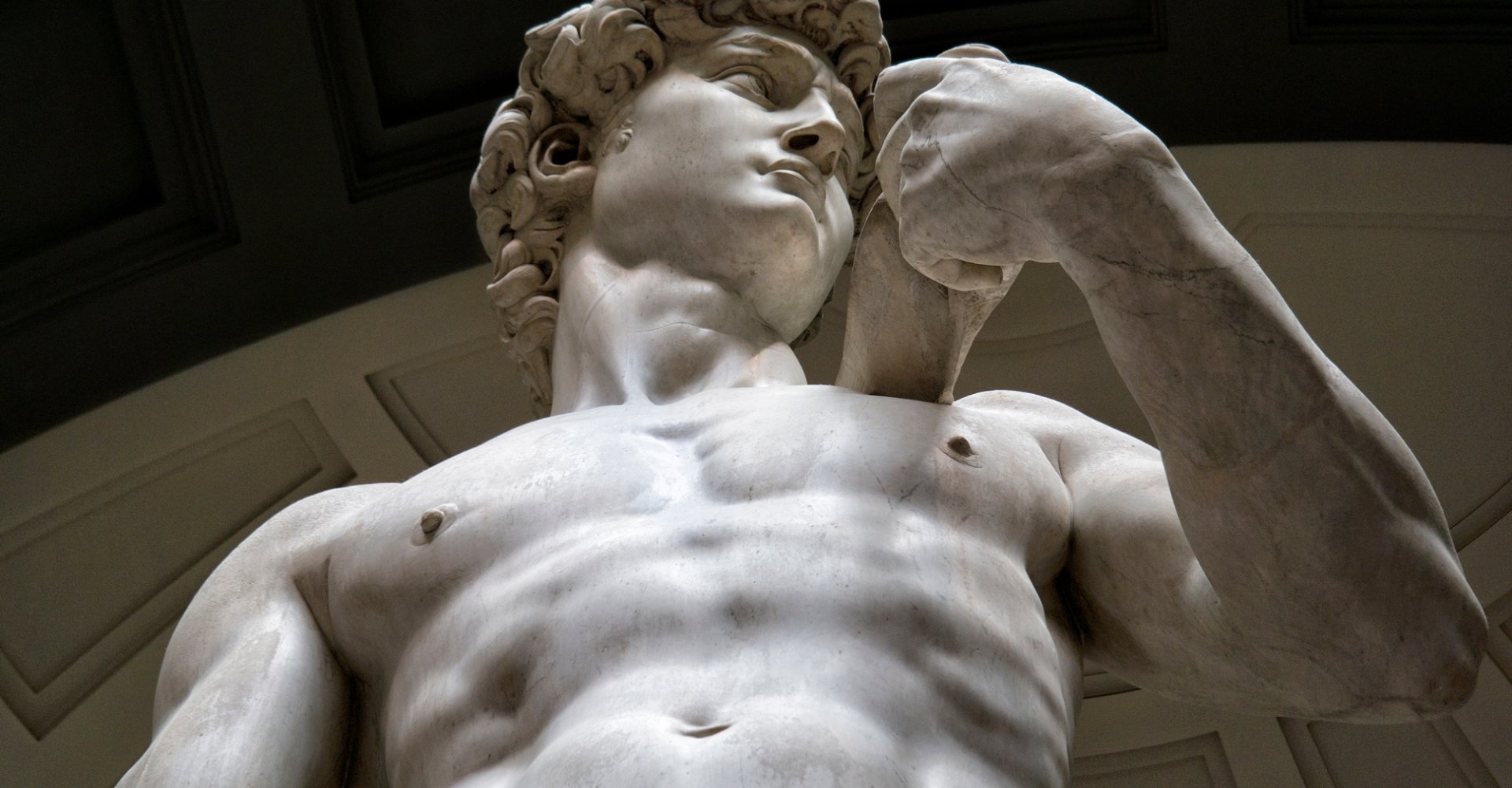
Michelangelo's David is one of the most recognizable sculptures in Western art and one of the greatest examples of Renaissance naturalism and idealized human anatomy. Created between 1501 and 1504, the marble sculpture depicts the biblical hero David before his battle with Goliath. Instead of showing David during the actual fight, Michelangelo captures the moment just before the action begins. David stands alert and focused, looking toward his enemy with intense concentration. This choice gives the sculpture a strong sense of psychological tension because the viewer knows that something dramatic is about to happen.
The subject of David was especially meaningful in Renaissance Florence. According to the Bible, David was a young Israelite who defeated the much larger warrior Goliath using a sling and a stone. His victory became a symbol of courage, intelligence, and faith overcoming strength. In Florence, David had also become a political symbol. The city saw itself as a small but independent republic surrounded by more powerful enemies. David's victory over Goliath therefore represented the idea that a smaller power could successfully defend itself against a larger one.
Michelangelo's David reflects the ideals of the High Renaissance through its balance, ideal proportions, and carefully studied anatomy. The figure is based on the classical tradition of presenting the male body as beautiful, powerful, and harmonious. However, Michelangelo does not simply copy ancient sculpture. He adds an intense psychological quality to the figure. David's facial expression, tense hands, and posture suggest that he is thinking carefully about what is about to happen.
The sculpture also demonstrates Michelangelo's use of naturalism. The veins, muscles, bones, and proportions of David's body are carefully observed. However, Michelangelo intentionally exaggerated certain parts of the body. David's hands and head are larger than would be completely natural, which makes them more visually powerful from the original intended viewing position. The sculpture was originally planned to be placed high above the ground, so Michelangelo adjusted the proportions to make the figure appear correct from below.
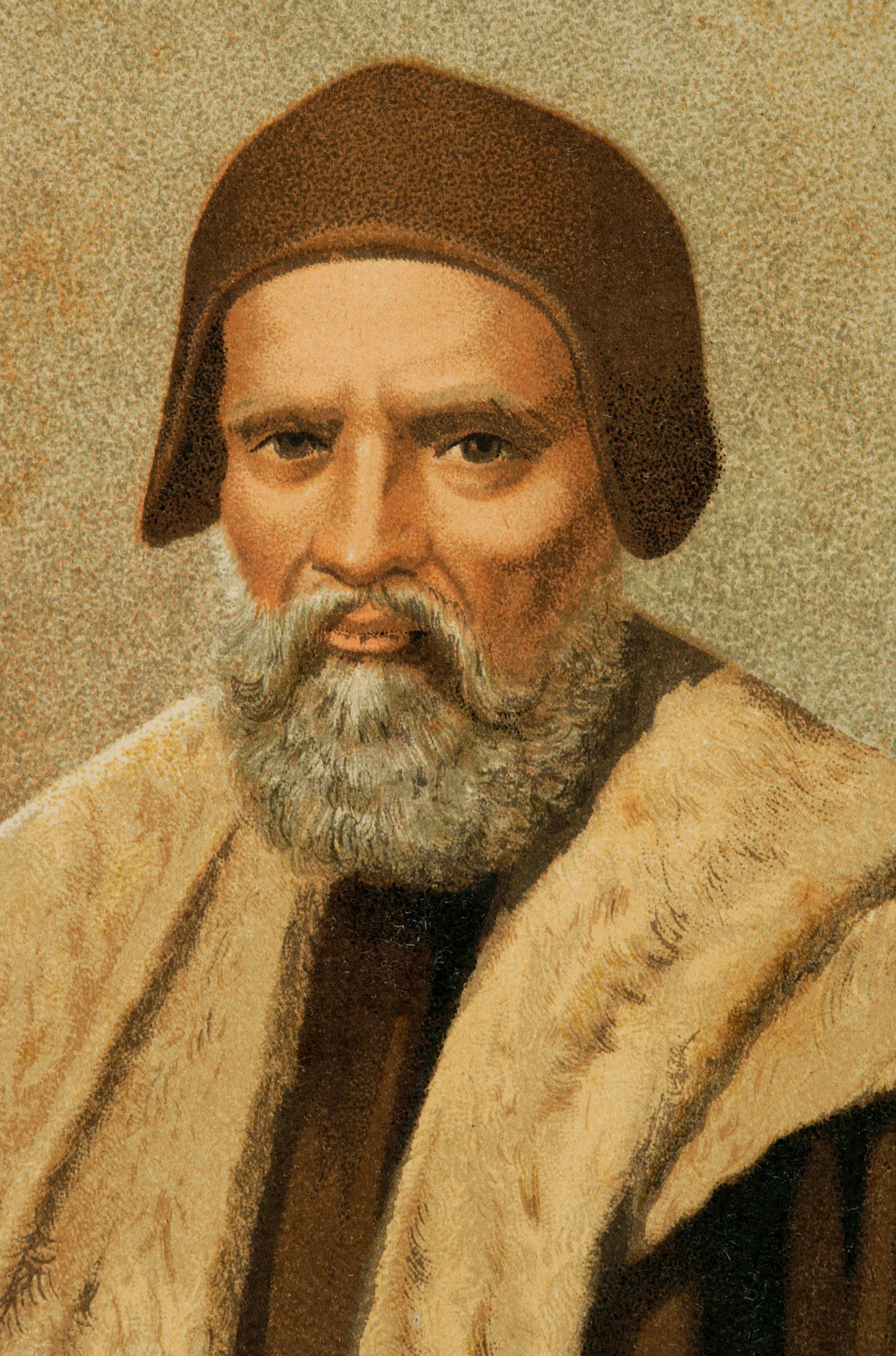
Michelangelo was born in 1475 and grew up in Florence, which was one of the most important artistic centers of Renaissance Italy. He studied art under important Florentine artists and was influenced by the sculptures of classical antiquity as well as the work of artists such as Donatello. His understanding of anatomy also came from studying the human body closely. Michelangelo's interest in anatomy helped him create figures that appeared physically convincing while still reaching an idealized level of beauty.
The David was carved from a single block of marble that had already been partially worked on by other sculptors. The stone was unusually narrow and difficult to use, but Michelangelo transformed it into a monumental figure. His technique allowed the body to appear as though it were naturally emerging from the marble. The sculpture is also an example of contrapposto, a pose in which the body's weight rests primarily on one leg, creating a natural shift through the hips and shoulders.
Within Emotion in Motion, David represents emotion before movement. Unlike a Baroque artwork that might show the exact moment of action, Michelangelo freezes the moment immediately before David acts. The tension in his body and expression allows viewers to imagine what will happen next. The sculpture therefore demonstrates that emotion does not always require dramatic movement. Sometimes the anticipation of movement can be just as powerful.
Michelangelo, Pietà and David
Michelangelo, Pietà and David
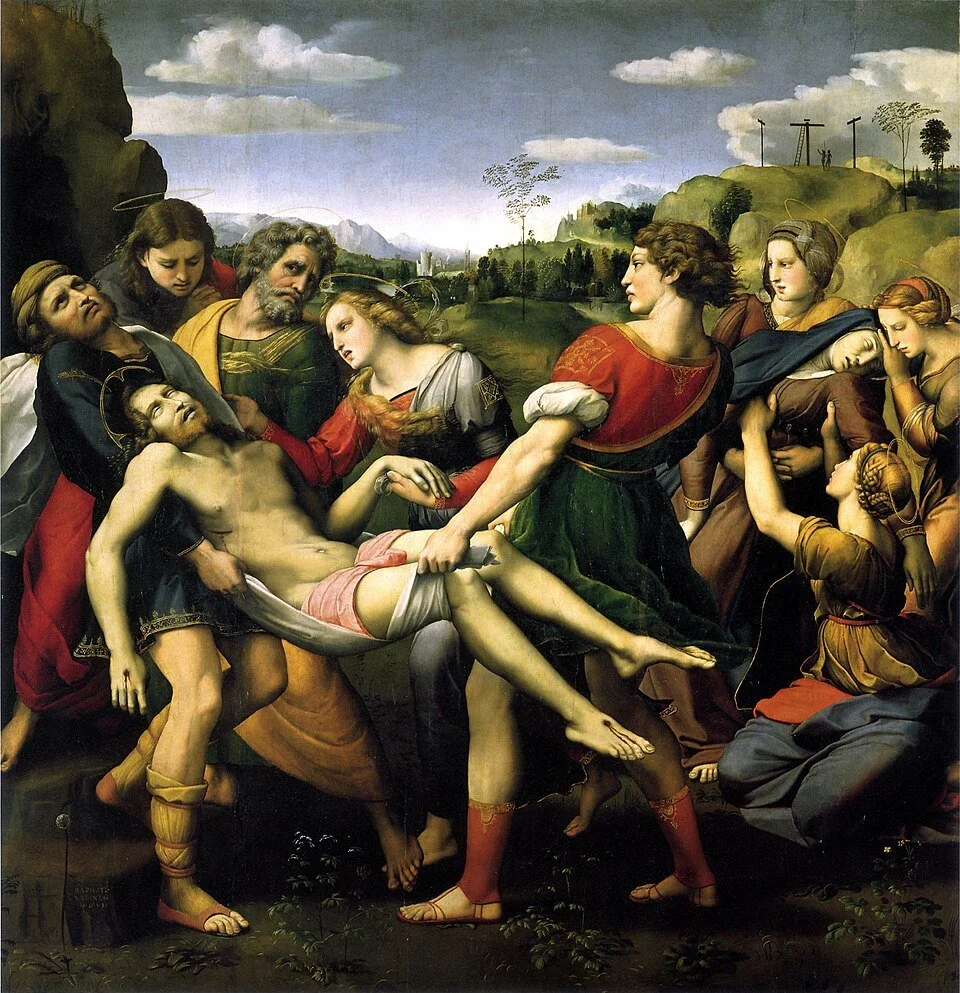
Raphael's The Deposition, completed in 1507, depicts the removal of Christ's body from the cross following the Crucifixion. The painting shows several figures carrying Christ's body toward his tomb while the Virgin Mary and other mourners react to his death. The subject comes from the New Testament and focuses on the emotional aftermath of Christ's Crucifixion. Instead of showing the violence of the Crucifixion itself, Raphael focuses on grief, mourning, and the physical burden of Christ's body.
Raphael was one of the most important artists of the High Renaissance and was known for his balanced compositions, graceful figures, and idealized beauty. Born in Urbino in 1483, Raphael trained under artists in central Italy before eventually moving to Florence and then Rome. His work was influenced by Leonardo da Vinci and Michelangelo, two artists whose ideas about composition, anatomy, and human emotion helped shape his own style. Raphael became especially famous for his paintings of the Virgin Mary and for his work in the Vatican.
The Deposition was commissioned by Atalanta Baglioni for an altar in the church of San Francesco al Prato in Perugia. The commission had a personal connection to grief because Baglioni had lost her son, Grifonetto, during a violent political conflict. This connection gives the painting an additional emotional layer. The subject of Christ's death and burial could have been understood not only as a religious story but also as an expression of personal mourning.
Raphael's style differs from the later drama of Baroque artists. His figures are arranged in a carefully organized composition, and their bodies move gracefully through space. At the same time, the painting contains more movement than some earlier Renaissance works. The figures carrying Christ create a diagonal movement across the composition, while the gestures of the mourners direct the viewer's attention toward Christ and the Virgin Mary.
Raphael used naturalism to make the figures appear believable, but he also idealized their bodies and faces. Their expressions communicate grief without becoming exaggerated. The colors are bright and carefully organized, helping separate the different figures while creating harmony throughout the painting. Raphael was also interested in the influence of classical sculpture, which can be seen in the idealized bodies and graceful poses.
The painting's meaning centers on grief, sacrifice, and the connection between Christ's death and human suffering. The Virgin Mary's reaction is especially important because she represents both a mother mourning her child and a central figure in Christian belief. The painting encourages viewers to connect their own experiences of loss with the religious story.
In Emotion in Motion, The Deposition acts as a bridge between the Renaissance and the more dramatic Baroque period. Raphael maintains Renaissance balance and ideal beauty but introduces more movement and emotional action. It helps visitors see that the transition from Renaissance to Baroque was not sudden. Instead, artists gradually experimented with ways to make religious scenes more emotionally engaging and physically dynamic.
Raphael, The Deposition

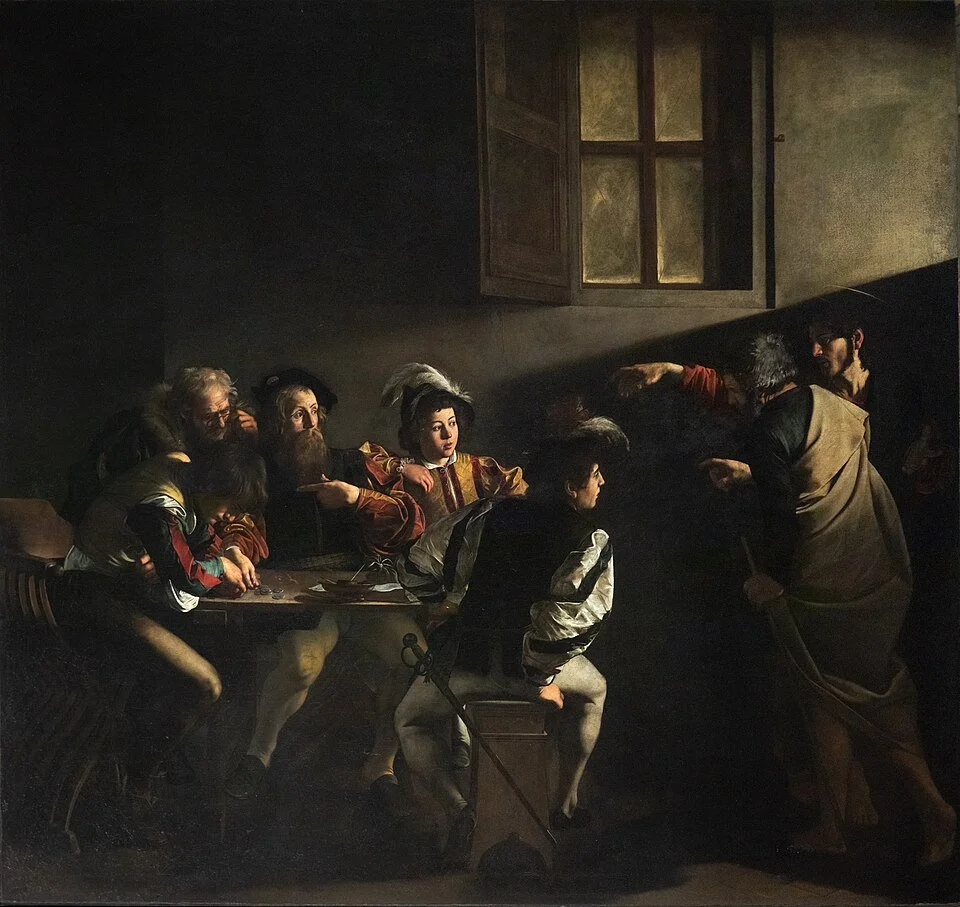
Caravaggio's The Calling of Saint Matthew is one of the most important paintings of the early Baroque period. Created around 1599–1600, it depicts the biblical moment when Jesus calls Matthew to become one of his apostles. Matthew is shown sitting with a group of men who are counting money when Jesus enters the room and points toward him. Matthew's reaction is uncertain, as though he is surprised that Jesus is speaking to him. This creates a very human and relatable moment of religious transformation.
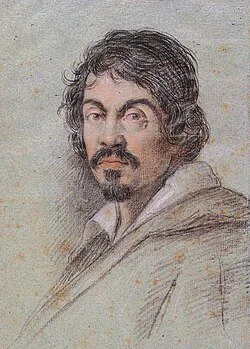
Caravaggio was born Michelangelo Merisi in Milan around 1571 and later became known by the name of his hometown, Caravaggio. He trained as a painter in Milan before moving to Rome, where he became famous for his dramatic paintings of religious subjects. His work was very different from the idealized figures associated with the High Renaissance. Instead, Caravaggio frequently used ordinary-looking people as models and emphasized realistic bodies, clothing, and expressions.
The painting was commissioned for the Contarelli Chapel in the church of San Luigi dei Francesi in Rome. It was part of a larger group of paintings about the life of Saint Matthew. The commission was connected to Cardinal Matteo Contarelli, whose name was Matthew. The paintings were intended to teach religious stories while also creating a powerful emotional experience for viewers.
One of the most important features of the painting is Caravaggio's use of chiaroscuro, the strong contrast between light and dark. A beam of light enters the dark room and falls across the figures. This creates a dramatic focus on Matthew and the people around him. Caravaggio takes this technique even further through tenebrism, in which large areas of the composition are swallowed by deep darkness while selected figures and details are strongly illuminated.
Caravaggio's use of naturalism is equally important. The people in the painting do not look like perfect Renaissance figures. They look like ordinary people from Caravaggio's own world. Their clothing resembles contemporary clothing rather than ancient biblical costumes, making the story feel as though it is happening in the viewer's own time.
The painting's meaning is about divine calling and transformation. Matthew is presented as an ordinary person who is unexpectedly chosen by Christ. The dramatic beam of light can be interpreted as a symbol of divine intervention. Caravaggio's decision to make the biblical story look like an everyday scene makes the religious message feel immediate and personal.
This painting is central to Emotion in Motion because it demonstrates how Baroque artists used lighting, naturalism, and psychological reactions to involve viewers. Caravaggio does not simply tell viewers that Matthew has been called. He makes the viewer feel the surprise and uncertainty of the moment. The combination of darkness, light, gesture, and realistic figures turns a religious story into a dramatic human experience.
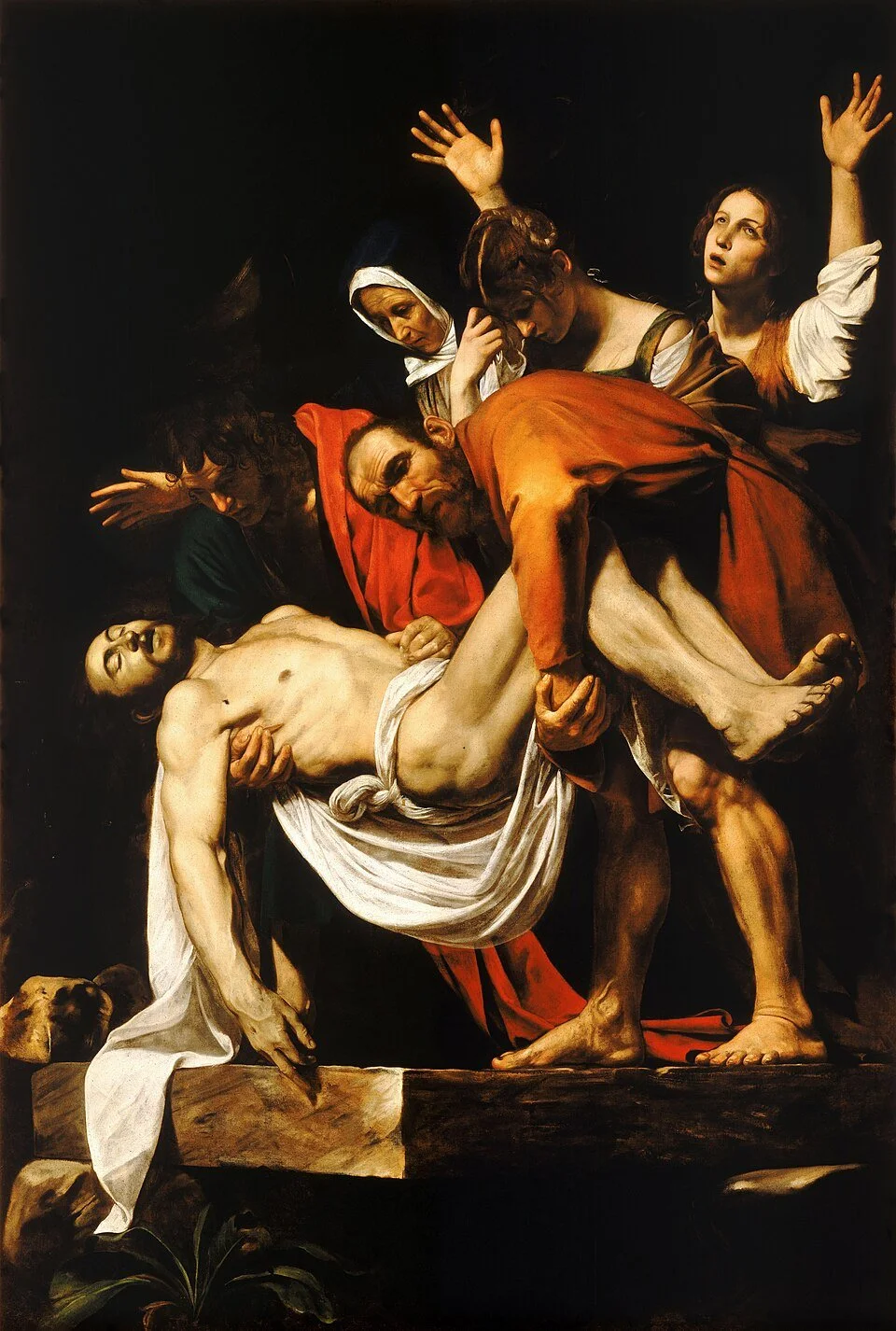
Caravaggio, The Calling of saint matthew and The entombment of christ
Caravaggio's The Entombment of Christ, created between 1603 and 1604, depicts the moment when Christ's followers carry his body toward the tomb after the Crucifixion. The painting includes Christ, Saint John, Nicodemus, the Virgin Mary, Mary Magdalene, and another woman mourning. The figures are shown in a tightly organized group, with Christ's body extending toward the viewer. The painting focuses on the emotional and physical reality of death rather than presenting the scene as distant or idealized.
The work was commissioned for the Chapel of the Pietà in the church of Santa Maria in Vallicella in Rome, also known as the Chiesa Nuova. It was created during a period when religious art was expected to communicate Christian teachings clearly and emotionally. This was the era of the Counter-Reformation, when the Catholic Church responded to the Protestant Reformation and encouraged religious artworks that could inspire faith and emotional involvement.
Caravaggio's style was revolutionary because of its combination of naturalism, dramatic composition, and intense lighting. His figures appear like real people rather than idealized saints. Their bodies have weight, and the people carrying Christ seem to struggle with the physical effort of supporting him. Christ's arm hangs downward toward the viewer, emphasizing his dead weight and making his body feel physically present.
Caravaggio's use of chiaroscuro and tenebrism is especially important. The background is extremely dark, while the figures are illuminated from above and to the side. This creates a strong contrast between light and shadow and directs the viewer's attention toward Christ and the mourners. The darkness also creates a solemn atmosphere, making the brightly lit figures seem to emerge from the surrounding space.
Caravaggio was influenced by the Renaissance masters, particularly their interest in naturalistic human bodies, but he rejected the idealized perfection that characterized much Renaissance art. Instead, he believed religious figures could be more emotionally powerful when they looked like real people. His work was also influenced by the Counter-Reformation's desire for art that could communicate directly to ordinary worshippers.
The painting's meaning centers on grief, sacrifice, and the humanity of Christ. The viewer is placed close to the action, almost at the edge of the tomb. The large stone slab at the bottom of the painting seems to extend toward the viewer, making the boundary between the painted world and the viewer's world feel very thin.
In Emotion in Motion, The Entombment of Christ represents the transition into a much more emotionally intense style. Compared with Michelangelo's calm Pietà, Caravaggio's painting makes grief physical and immediate. The combination of naturalism, movement, chiaroscuro, and tenebrism creates an emotional experience that asks viewers not just to understand Christ's death but to feel the weight of the moment.
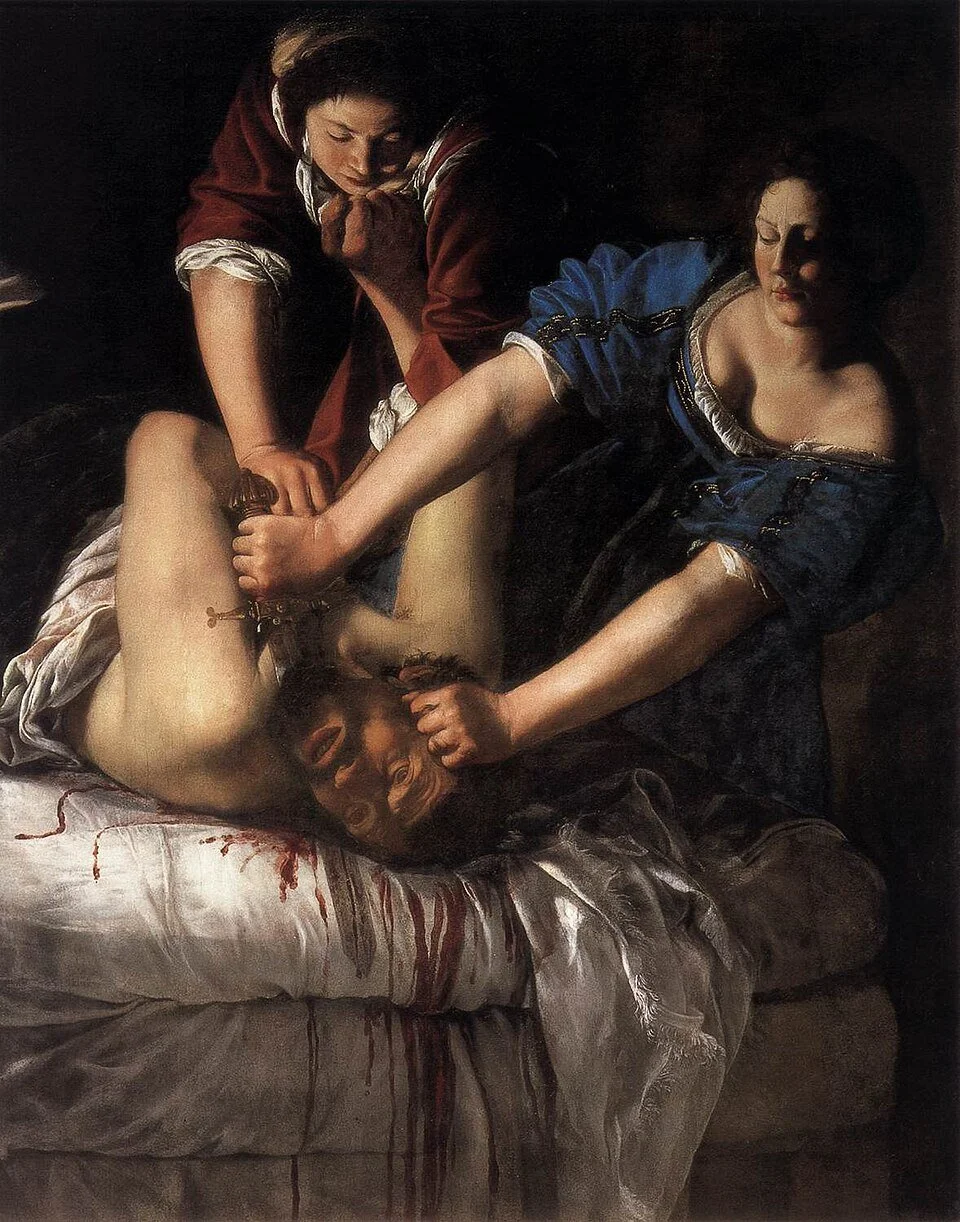

Artemisia, Judith slaying holofernes
Artemisia Gentileschi's Judith Slaying Holofernes is one of the most dramatic paintings of the Baroque period. Based on a story from the biblical Book of Judith, the painting depicts Judith and her servant Abra killing the Assyrian general Holofernes. Judith has entered his tent after gaining his trust and then attacks him while he is vulnerable. Gentileschi chooses to depict the action at its most intense moment, making the viewer feel as though the event is happening directly in front of them.
Artemisia Gentileschi was born in Rome in 1593 and became one of the most successful female painters of the seventeenth century. Her father, Orazio Gentileschi, was a painter who trained her in his workshop. Artemisia became particularly known for paintings of powerful women from biblical and mythological stories. She worked in Florence, Rome, Venice, Naples, and other Italian cities and received important commissions during a period when female professional artists faced significant barriers.
Gentileschi's painting is often connected to her personal experiences, although it is important not to reduce the work entirely to her biography. As a young woman, Artemisia was sexually assaulted by the artist Agostino Tassi and was subjected to a public trial. Her experience of violence and the difficulties she faced afterward have led many scholars to consider the importance of gender and power when interpreting her paintings. However, Judith Slaying Holofernes also belongs to a much larger artistic tradition of depicting Judith as a symbol of courage and victory over oppression.
The painting demonstrates several characteristics of the Baroque style, especially movement, drama, strong emotion, and naturalism. Gentileschi uses tenebrism to place the figures against a dark background. A strong light illuminates Judith, Abra, and Holofernes, making the action immediately visible. The lighting is similar to the dramatic approach used by Caravaggio, whose work strongly influenced Gentileschi and her father.
Gentileschi also uses naturalism to make the physical struggle believable. Judith and Abra use their bodies to restrain Holofernes, and their clothing and muscles respond to the movement of the scene. Unlike many earlier depictions in which Judith appears passive or hesitant, Gentileschi presents her as physically and psychologically determined.
The painting's meaning involves strength, courage, justice, and the reversal of power. Judith is not simply a beautiful woman observing a violent event; she is the person controlling the situation. Her active role challenges traditional expectations of female weakness and makes the painting particularly powerful.
Within Emotion in Motion, Gentileschi's painting represents the extreme end of Baroque emotional storytelling. Michelangelo's Pietà communicates grief through stillness, while Gentileschi creates emotion through physical action and tension. Her use of tenebrism, naturalism, dramatic gestures, and intense expressions makes the viewer feel caught in the middle of the story. The painting demonstrates how Baroque artists transformed biblical stories into emotionally immediate experiences.
Artemisia, Judith slaying holofernes
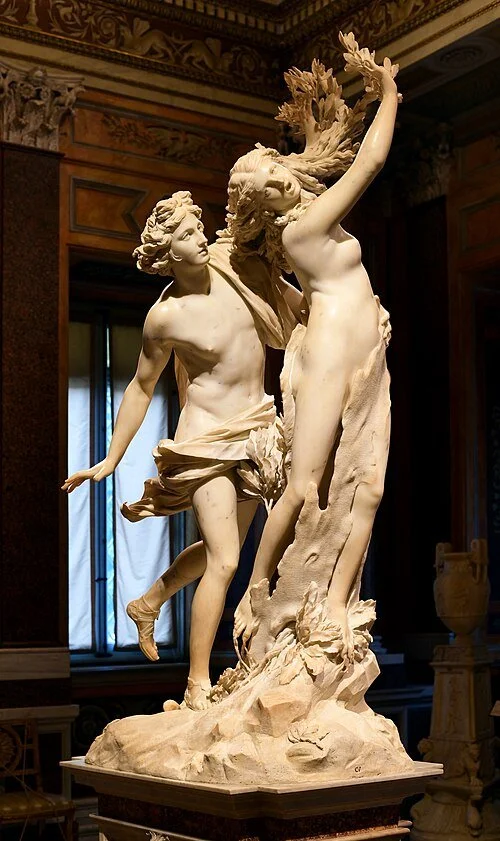
Bernini's Apollo and Daphne is one of the greatest examples of movement and transformation in Baroque sculpture. Created between 1622 and 1625, the sculpture depicts a moment from the ancient Roman poet Ovid's Metamorphoses. Apollo has fallen in love with Daphne, but Daphne does not return his feelings and tries to escape. When Apollo catches up to her, she asks her father, the river god Peneus, to save her. He transforms her into a laurel tree, and Bernini captures the exact moment when this transformation begins.
The sculpture was commissioned by Cardinal Scipione Borghese, one of Bernini's most important patrons. Bernini was born in Naples in 1598 and became the leading sculptor and architect of seventeenth-century Rome. He worked for popes, cardinals, and wealthy patrons and helped define the visual style of the Baroque period. His work was strongly influenced by ancient Greek and Roman sculpture, but he pushed classical ideas toward greater movement and emotional intensity.
One of the most impressive qualities of Apollo and Daphne is its ability to make marble appear to move. Daphne's fingers are becoming branches, her hair transforms into leaves, and her feet begin turning into roots. Bernini carefully carved the marble so that the textures of skin, hair, bark, and leaves appear different from one another. The sculpture shows an extraordinary understanding of the possibilities of marble.
Bernini also uses contrapposto, but he pushes the pose much further than Renaissance sculptors. The figures twist and stretch through space, creating a spiral-like movement. Apollo's body moves forward while Daphne moves away from him. Their bodies create a visual sequence that encourages the viewer to walk around the sculpture and experience the transformation from different viewpoints.
The subject comes from classical mythology, but Bernini's sculpture has a moral message as well. At the base of the sculpture is an inscription connected to the story's lesson about the fleeting nature of desire. Apollo's pursuit of Daphne ultimately leads to her transformation, showing how quickly beauty and desire can change.
In Emotion in Motion, Apollo and Daphne is one of the clearest examples of the exhibition's title. The sculpture literally captures movement in progress. Daphne is not simply shown as a tree or as a woman; she is shown during the moment of transformation between the two. Bernini makes viewers feel the urgency of the chase and the emotional tension between the figures. This is very different from Michelangelo's David or Pietà, where the figures are more stable and controlled. Bernini's sculpture demonstrates how Baroque artists wanted art to feel active, theatrical, and alive.
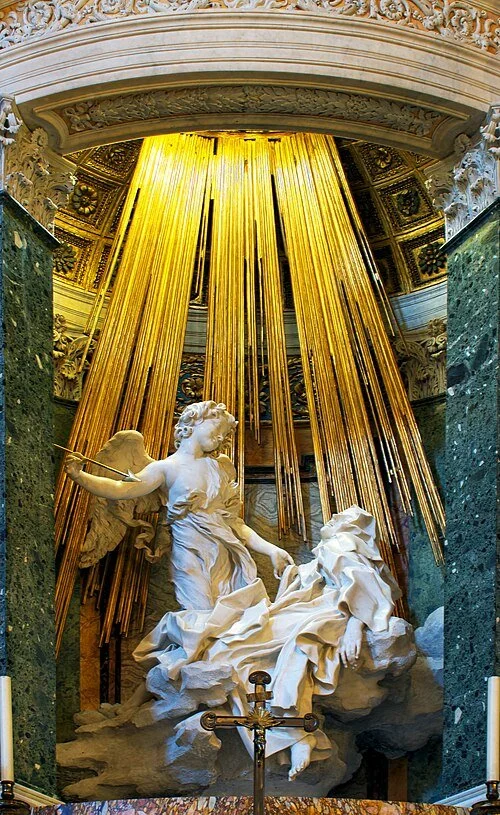
Bernini, Apollo and Daphne, and Ecstasy of Saint teresa
Bernini's Ecstasy of Saint Teresa is one of the most famous examples of Baroque art and one of the most ambitious religious sculptures of the seventeenth century. Created between 1647 and 1652, the work depicts Saint Teresa of Ávila during a mystical religious experience. According to Teresa's own writings, an angel appeared to her and pierced her heart with a divine arrow, causing a combination of spiritual pain and overwhelming religious joy. Bernini captures this moment of spiritual transformation through sculpture, architecture, light, and theatrical presentation.
The sculpture was commissioned by Cardinal Federico Cornaro for the Cornaro Chapel in the church of Santa Maria della Vittoria in Rome. Rather than being designed as an independent sculpture, Ecstasy of Saint Teresa was created specifically for the chapel. This makes the entire space part of the artwork. Members of the Cornaro family are shown in sculpted balconies on either side, appearing to watch the vision. This creates the feeling of a theater, with Teresa and the angel acting as the central performers.
Bernini was born in Naples in 1598 and became one of the most important artists of Baroque Rome. He worked as a sculptor, architect, and designer and was closely connected to the Catholic Church. His work was shaped by the religious goals of the Counter-Reformation, which encouraged artists to create emotionally powerful images that could strengthen viewers' faith.
The sculpture's style is distinctly Baroque because of its dramatic movement, theatrical composition, intense emotion, and combination of different artistic forms. Teresa's body appears to sink into the clouds while her clothing spreads outward in deep, energetic folds. Her expression is one of intense spiritual experience. The angel is lighter and more graceful, creating a contrast between the heavy folds of Teresa's clothing and the delicate figure of the angel.
Bernini also uses light as part of the artwork. Hidden windows allow natural light to enter the chapel and illuminate the golden rays behind the figures. This lighting effect is essential to the meaning of the sculpture. The light appears to come from heaven, making the supernatural vision seem to occur within the physical space of the chapel.
Bernini's work was influenced by classical sculpture, but he transformed classical ideas into something much more theatrical. He also drew from the religious writings of Saint Teresa, whose descriptions of mystical experiences gave him the subject matter for the work. The sculpture's meaning is centered on the relationship between physical and spiritual experience. Teresa's body appears overwhelmed, but the scene is presented as a moment of divine connection rather than ordinary physical suffering.
The Ecstasy of Saint Teresa is perhaps the most direct expression of Emotion in Motion in the exhibition. Unlike Michelangelo's quiet Pietà, Bernini uses every possible artistic element—sculpture, architecture, light, gesture, texture, and space—to create an emotional experience. The viewer is not simply looking at a religious event; the viewer is placed inside a carefully designed environment intended to make the supernatural feel real. It represents the Baroque belief that art could move the body, the senses, and the emotions all at once.
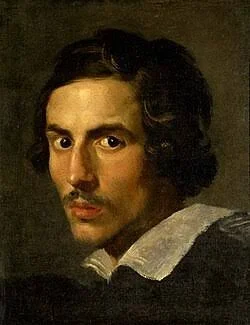
“The true work of art is but a shadow of the divine perfection.”
Michelangelo di Lodovico Buonarroti Simoni